Watercolor Printable To-Do List: A Functional and Aesthetic Planning Tool
Effective organization often hinges on the tools we choose to manage our daily responsibilities. While digital applications offer convenience, many professionals and creatives find that physical planning aids provide a necessary cognitive break from screen fatigue. The Watercolor Printable To-Do List represents a hybrid solution, combining the tactile satisfaction of paper planning with the flexibility of digital assets. This resource is designed for individuals who require structured task management but also value an aesthetic environment that reduces stress and promotes focus. Unlike generic office supplies, this specific printable asset integrates soft watercolor accents that serve a psychological purpose: softening the rigidity of productivity tracking while maintaining professional utility.
Evaluating Design Utility and Cognitive Impact
The primary distinction of this Watercolor Printable To-Do List lies in its balance between form and function. In professional settings, stark black-and-white lists can sometimes feel clinical or overwhelming, potentially increasing anxiety rather than alleviating it. The inclusion of watercolor elements introduces color theory into workflow management without sacrificing readability. Soft blues, greens, or pastels have been shown to promote calmness and sustained attention, making this format particularly suitable for high-stress professions or creative workflows where mental clarity is paramount.
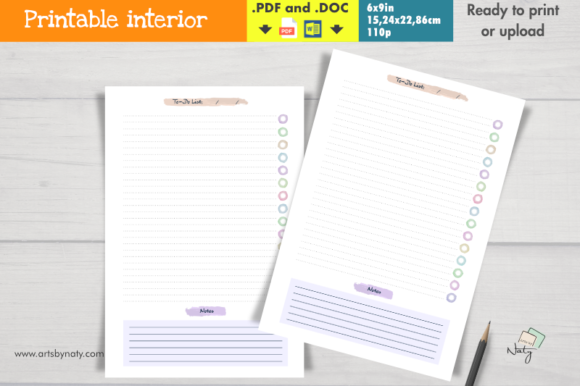
From a usability standpoint, the design prioritizes whitespace and clear hierarchy. A common failure in decorative planners is the sacrifice of writing space for ornamentation. However, this template maintains ample room for task entry, checkboxes, and notes. The 6x9 inch (15.24 x 22.86 cm) trim size is significant; it mirrors standard trade paperback dimensions, making it portable enough for field work, client meetings, or commuting, yet substantial enough to serve as a primary daily log. For users integrating this with the matching "Weekly Priorities Planner in Watercolor," the visual consistency helps create a cohesive system that reduces the friction of switching between different planning modalities.
Technical Specifications and Print Readiness
For publishers, educators, or entrepreneurs intending to use this as a lead magnet, internal team resource, or retail product, technical quality is non-negotiable. This asset package addresses several critical production requirements:
- High-Resolution Output: The bonus single-page JPG is provided at 300dpi in A4 size (8.27 x 11.69 inches). This resolution is the industry standard for crisp printing, ensuring that watercolor gradients do not appear pixelated or banded when printed on home or commercial equipment.
- Editability: The inclusion of a DOC file allows for necessary customization. Users can modify the "This notebook belongs to" page and the copyright notice, which is essential for branding purposes or personalizing gifts for clients and employees.
- Commercial Safety: The explicit confirmation of no watermarks ensures the final output is professional. Whether used internally or sold as part of a larger bundle, the absence of vendor branding protects the user’s intellectual property and brand integrity.
- Page Count Optimization: At 110 pages, the PDF is sized appropriately for perfect binding or coil binding. This count provides roughly three to four months of daily tracking or six months of bi-daily use, offering substantial long-term value compared to thinner, disposable tear-off pads.
Practical Applications Across Professional Contexts
The versatility of a Watercolor Printable To-Do List extends beyond personal household management. Its specific characteristics make it adaptable to various professional niches, provided the user understands how to leverage the asset effectively.
For Freelancers and Creatives
Creative professionals often struggle with rigid corporate planning systems that stifle ideation. The aesthetic nature of this list aligns with creative sensibilities, making the act of planning feel like an extension of the creative process rather than an administrative burden. Freelancers can utilize the editable DOC file to add their business logo or contact information, turning a simple to-do list into a branded touchpoint when meeting with clients. The 6x9 size fits easily into messenger bags alongside sketchbooks or tablets, facilitating analog capture during brainstorming sessions.
For Educators and Coaches
Teachers and coaches frequently require handouts that are engaging yet functional. Printing a standard lined list for students or coaching clients can feel impersonal. By utilizing this watercolor template, educators can provide resources that feel curated and thoughtful. The ability to edit the copyright page allows instructors to assert ownership over distributed materials or customize the header for specific courses or workshops. Furthermore, the calming visual style is particularly beneficial in special education or therapeutic coaching contexts, where reducing visual overstimulation is a key objective.
For Small Business Owners and Marketers
In marketing and small business operations, consistency builds trust. Using a visually aligned suite of planning tools—including this list and the matching weekly planner—creates internal brand cohesion. Business owners can print these as onboarding welcome kits for new hires or as value-add bonuses for digital course purchases. The availability of both PDF and DOC formats ensures that marketing teams can quickly adapt the asset for different campaigns without needing to hire a graphic designer for minor text changes.
Assessing Limitations and Workflow Integration
While the Watercolor Printable To-Do List offers distinct advantages, objective evaluation requires acknowledging its limitations. Understanding these constraints helps users determine if this tool aligns with their specific operational needs.
Color Printing Costs: Watercolor aesthetics rely heavily on color reproduction. While the 300dpi files are optimized for quality, printing 110 full-color pages at home can be cost-prohibitive due to ink consumption. Users should calculate the cost-per-page before committing to large-scale home printing. Alternatively, utilizing print-on-demand services or local commercial printers may yield better economic results for bulk orders. For those strictly limited to black-and-white printing, the watercolor elements may lose some of their intended impact, appearing as grey washes rather than vibrant accents.
Editing Constraints: While the DOC file allows for text editing, it does not permit manipulation of the watercolor graphics themselves. Users looking to change the color palette or move artistic elements will need additional vector or raster editing software and skills. The editability is functional (text replacement) rather than structural (design modification).
Analog Dependency: As a printable asset, this tool requires physical interaction. It does not sync with digital calendars, project management software, or cloud storage automatically. Professionals who rely entirely on digital ecosystems may find this creates data silos. It is best utilized as a complementary capture tool or a dedicated focus aid, rather than a replacement for comprehensive digital project management systems.
Determining Suitability and Long-Term Value
The decision to adopt this Watercolor Printable To-Do List should be based on specific workflow gaps rather than aesthetic preference alone. It is most valuable for users who:
- Experience planning fatigue or resistance to traditional organizational methods.
- Require a branded, professional-looking physical asset for client-facing interactions.
- Need a customizable template that eliminates the time and expense of hiring a designer for basic planning collateral.
- Value portability and the cognitive benefits of handwriting tasks.
Conversely, teams requiring real-time collaboration, automated reminders, or strict monochrome printing may find better utility in digital alternatives or minimalist black-and-white templates.
Ultimately, the effectiveness of any planning tool is measured by its consistent use. The Watercolor Printable To-Do List succeeds by lowering the barrier to entry through visual appeal and providing sufficient structural support through practical formatting. When paired with the Weekly Priorities Planner, it forms a robust analog system capable of supporting complex professional lives. The inclusion of multiple file formats and high-resolution assets demonstrates an understanding of diverse user needs, from the individual seeking personal organization to the publisher creating commercial products. By treating this printable not merely as stationery but as a strategic productivity asset, users can extract significant return on investment through improved focus, enhanced professional presentation, and streamlined workflow management.