Evaluating 30 Kakuro Puzzles Grid Vol.4 for Activity Books and Personal Use
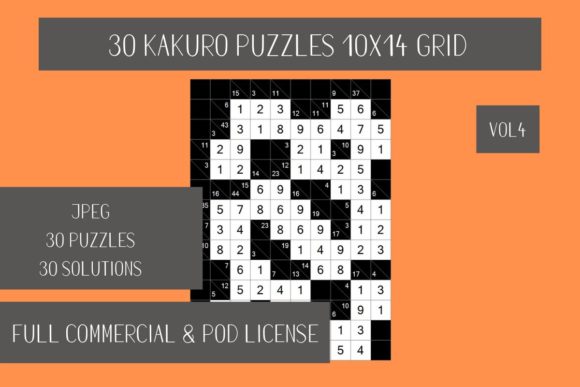
When sourcing logic puzzles for publication or personal enrichment, the specific technical parameters of the asset are often just as important as the puzzle content itself. 30 Kakuro Puzzles Grid Vol.4 represents a specialized resource designed for creators and enthusiasts who require clean, high-resolution assets without the friction of watermarks or restrictive licensing. Unlike generic puzzle generators that produce low-quality outputs, this collection provides 30 distinct JPEG files at 601×841 pixels with 96 dpi resolution, formatted specifically for a 10×14 grid layout. Understanding where this volume fits within the broader ecosystem of Kakuro resources requires examining its format, difficulty balance, and practical application compared to alternative sourcing methods.
Technical Specifications and Format Utility
The primary differentiator for any digital puzzle asset is its readiness for print or digital integration. This collection delivers files at 601×841 pixels, which translates to a printable area of approximately 6.25 by 8.75 inches at 96 dpi. For activity book creators targeting standard trade paperback sizes (such as 6x9 or 8.5x11), these dimensions offer significant flexibility. The 10×14 grid size is a critical specification; it sits in the "medium-large" category of Kakuro design. This grid density allows for more complex logical intersections than a standard 8x8 beginner grid, yet remains less daunting than the massive 16x16 grids found in expert anthologies.
The inclusion of separate solution files for all 30 puzzles addresses a common pain point in puzzle acquisition. Many free or low-cost resources provide puzzles without verified solutions, forcing publishers to solve them manually to ensure accuracy before printing. With 30 Kakuro Puzzles Grid Vol.4, the verification step is eliminated. The absence of watermarks further streamlines the workflow, removing the need for graphic design cleanup or vector tracing. This makes the asset particularly valuable for self-publishers using platforms like Amazon KDP or Etsy, where interior file preparation time directly impacts profit margins.
Comparing Sourcing Options: Curated Volumes vs. Generators
Individuals researching Kakuro assets typically choose between three categories: algorithmic generators, public domain archives, and curated commercial volumes like this one. Each approach carries distinct tradeoffs regarding quality, uniqueness, and legal safety.
Algorithmic Generators: Software tools can produce infinite Kakuro grids instantly. However, automated generation often results in aesthetic inconsistencies. Clues may be placed awkwardly, white space may be unbalanced, and the logical path to the solution can sometimes feel arbitrary rather than elegant. While generators are cost-effective for bulk content, they lack the human touch that defines a satisfying solving experience. In contrast, curated volumes typically undergo manual review to ensure the grid layout is visually balanced and the logic flow is engaging.
Public Domain Archives: Free repositories offer zero-cost entry but present significant risks for commercial users. Copyright status is often ambiguous, and image quality is frequently degraded through multiple re-uploads. Furthermore, popular public domain puzzles have been reused extensively, meaning your activity book may contain identical content to dozens of existing titles. 30 Kakuro Puzzles Grid Vol.4 mitigates this risk by providing a discrete, licensed set of assets that are less likely to be saturated in the current market.
Custom Commissioning: Hiring a puzzle constructor guarantees originality and perfect specification matching. However, the cost per puzzle can range from $2 to $10 depending on complexity. For a project requiring only 30 puzzles, commissioning might exceed the budget for a niche activity book. This volume serves as a middle-ground solution, offering professional-grade formatting and verified solutions at a fraction of custom development costs.
Evaluating the 10×14 Grid Complexity
The choice of a 10×14 grid is not arbitrary; it targets a specific segment of the adult solver demographic. When comparing this volume against other options, consider the intended audience's skill level:
- Beginner Resources (6x6 to 8x8): These grids rely on simple addition and single-step deductions. They are ideal for children or first-time solvers but often fail to retain adult users seeking a genuine cognitive challenge.
- Intermediate Resources (10x14): This is the sweet spot for general adult activity books. The 10×14 layout in 30 Kakuro Puzzles Grid Vol.4 requires multi-step lookahead and combination analysis without becoming tedious. It supports solve times ranging from 10 to 25 minutes, fitting well into commute or break-time usage patterns.
- Expert Resources (12x16+): Larger grids demand extensive notation and can take hours to complete. While impressive, they can alienate casual solvers and may not fit physically on standard book pages without reducing font size to illegible levels.
If your goal is to create a "coffee break" puzzle book or a mixed-logic anthology, the 10×14 format offers the optimal balance of challenge and accessibility. However, if you are compiling an "Extreme Logic" collection for competitive solvers, this volume may serve better as supplementary warm-up content rather than the primary feature.
Best-Fit Scenarios and Practical Applications
Determining whether this specific collection aligns with your needs depends heavily on your end-use case. Based on the technical specs and content volume, 30 Kakuro Puzzles Grid Vol.4 is most appropriate for the following scenarios:
Self-Published Activity Books: The 96 dpi resolution is optimized for digital viewing and standard home/office printing. While professional offset printing typically prefers 300 dpi, many print-on-demand services accept lower resolutions for line art if the source is clean. Users should verify their specific printer’s requirements. For digital-only products (PDF downloads, tablet apps), 96 dpi is native and crisp.
Educational and Cognitive Training Materials: Educators and therapists working with adults on executive function skills often need fresh material that doesn't look childish. The clean, watermark-free aesthetic allows these puzzles to be integrated into worksheets or cognitive rehabilitation packets without appearing unprofessional. The included solutions enable instructors to quickly verify student work or provide guided hints.
Newsletter and Blog Content: Content creators focusing on brain health or Japanese puzzles need regular visual assets. Having a bank of 30 pre-formatted images allows for consistent posting schedules without daily design work. The JPEG format ensures compatibility across virtually all web platforms and email marketing tools.
Limitations and Decision Factors
To make an informed decision, potential users must also understand what this product does not provide. Transparency regarding limitations prevents mismatched expectations.
Resolution Constraints: At 96 dpi, these files are excellent for screens and acceptable for some POD services, but they may appear soft when printed on glossy paper at large scales. If you are producing a premium hardcover coffee table book, you may need to vectorize these raster images or source higher-DPI originals. Always order a proof copy before committing to a full print run.
Format Rigidity: The files are delivered as JPEGs, which are raster-based. Unlike SVG or EPS formats, you cannot easily resize them without potential quality loss, nor can you edit individual clue numbers or grid lines without pixel manipulation. If you anticipate needing to modify puzzle clues or adjust grid spacing for layout purposes, this limitation is significant. This collection is best suited for users who want "ready-to-use" assets rather than customizable templates.
Volume Considerations: Thirty puzzles constitute a solid supplement or a mini-booklet, but may be insufficient for a full-length standalone puzzle book, which typically contains 80–100+ puzzles. Buyers planning a comprehensive title should view this volume as one component of a larger library or bundle it with other compatible sets to achieve desired page counts.
Making the Final Selection
Choosing the right Kakuro asset ultimately comes down to balancing production efficiency with quality standards. 30 Kakuro Puzzles Grid Vol.4 occupies a pragmatic niche: it offers verified, clean, intermediate-complexity puzzles in a format ready for immediate deployment. It eliminates the legal gray areas of free content and the time investment of custom creation.
For adults aged 20–50 evaluating resources for personal enjoyment or small-scale publishing, this collection provides a reliable baseline. It is particularly strong for those who value convenience and clear licensing over absolute customization. However, users requiring high-resolution print masters, editable source files, or expert-level challenges should continue their search or use this volume as part of a diversified sourcing strategy. By aligning the technical specifications of the puzzle set with the specific demands of your project, you ensure that the final product—whether a printed book, digital download, or educational tool—meets both functional requirements and user expectations for quality.