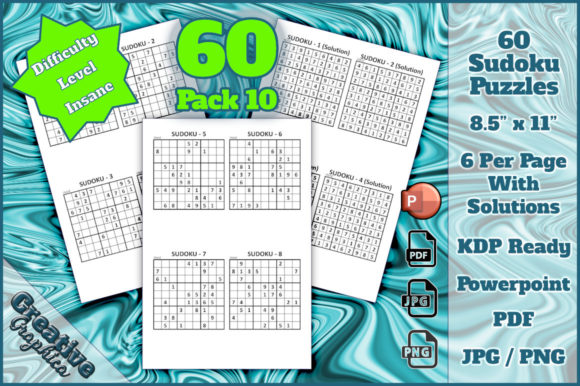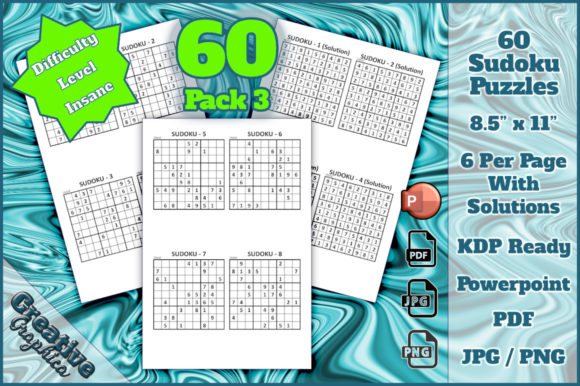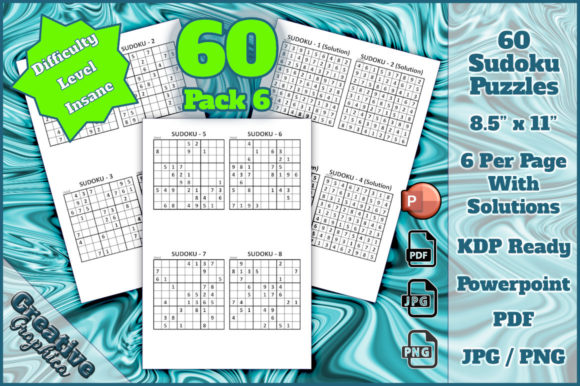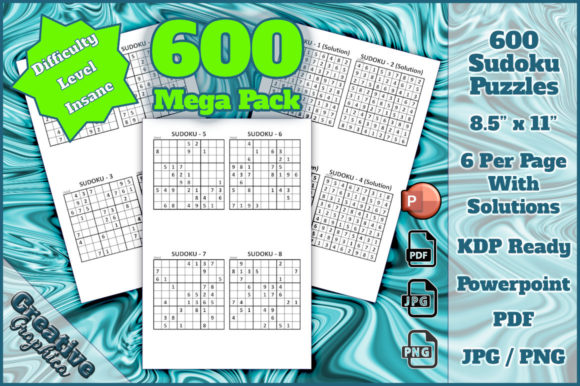
Maximizing the Utility of Sudoku 60 Puzzles Insane Pack 8 for Print and Digital Projects
Creating high-quality puzzle content requires a balance between cognitive challenge and technical precision. For publishers, educators, and content creators targeting advanced logic enthusiasts, Sudoku 60 Puzzles Insane Pack 8 serves as a comprehensive resource designed to streamline production workflows while maintaining professional standards. This collection is not merely a set of games; it is a structured asset library containing 60 unique, high-difficulty puzzles formatted specifically for commercial and educational application. Understanding the technical specifications and practical applications of this pack allows users to leverage its full potential across various media formats, from physical workbooks to digital learning platforms.
Technical Specifications and File Architecture
The efficacy of any digital asset lies in its resolution and format versatility. Sudoku 60 Puzzles Insane Pack 8 is engineered with multi-platform compatibility in mind, ensuring that visual integrity remains intact regardless of the output medium. The core of the package is built around high-resolution imagery and editable documents that cater to both print-on-demand services and digital distribution channels.
High-Resolution Image Assets
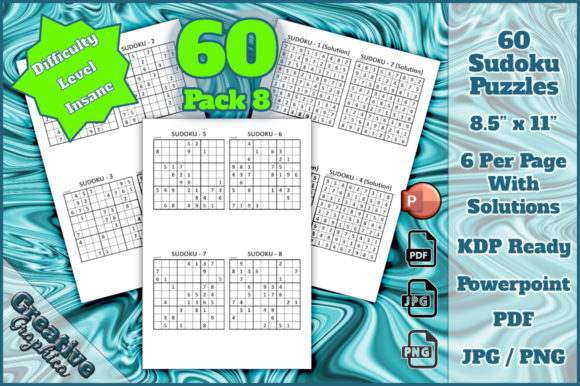
Visual clarity is paramount when presenting complex logic grids. The individual puzzle and solution files are provided at 300 DPI with dimensions of 1800px by 2700px. This resolution meets the industry standard for professional printing, ensuring that grid lines remain crisp and numbers are legible even when scaled. The pack includes two distinct image formats to address different storage and usage needs:
- JPG Files: These are included for maximum compatibility with legacy systems and specific print vendors that prefer JPEG compression. There are 10 JPG files for puzzles and 10 for solutions, each containing six puzzles per page.
- PNG Files: While noted as non-transparent, these PNGs offer a smaller file size compared to their JPG counterparts without sacrificing the 300 DPI quality. This makes them ideal for web-based applications, email newsletters, or digital downloads where bandwidth and load times are considerations. Like the JPGs, these are organized into 10 puzzle pages and 10 solution pages.
Document Formats for Editing and Printing
Beyond static images, the inclusion of editable and print-ready document formats significantly expands the utility of Sudoku 60 Puzzles Insane Pack 8. The PowerPoint (PPTX) template acts as a flexible master file. Containing 10 slides of puzzles and 10 slides of solutions, this format allows creators to rearrange content, add branding elements, or modify layouts without needing specialized graphic design software. The trim size is preset to 8.5 x 11 inches, aligning with standard US Letter paper and common workbook dimensions.
For direct production, a 20-page PDF file is included. This document is pre-configured with 300 DPI resolution and no bleed, featuring a preset 0.4-inch margin. This specific margin setting is crucial for print-on-demand platforms like Amazon KDP or IngramSpark, as it ensures that the puzzle grids remain within the safe zone during the binding and trimming process. The separation of puzzles and solutions within the PDF facilitates easy splitting if a creator wishes to publish the answer key as a separate downloadable file.
Strategic Applications Across Industries
The "Insane" difficulty level of these 60 unique puzzles positions them as a niche product for audiences who have mastered standard Sudoku variations. This specificity opens doors for several professional and recreational use cases.
Educational and Cognitive Training Resources
Educators and researchers focusing on adult learning, gerontology, or cognitive psychology can utilize these puzzles as standardized testing instruments or training modules. Because the difficulty is consistent and high, Sudoku 60 Puzzles Insane Pack 8 provides a reliable metric for assessing logical reasoning and pattern recognition under constraint. The clean, unbranded layout allows institutions to incorporate these grids into custom worksheets, exam papers, or therapeutic activity books without distracting visual noise. The availability of individual high-res images means specific puzzles can be isolated for slide presentations or digital whiteboard exercises.
Commercial Publishing and Self-Publishing
For independent authors and small press publishers, the cost of commissioning original, validated "insane" level Sudoku puzzles can be prohibitive. This pack offers a royalty-free foundation for creating derivative works. The intentional whitespace surrounding the six-puzzle-per-page layout is a critical design feature. This buffer zone allows publishers to add headers, footers, page numbers, difficulty ratings, or decorative borders without encroaching on the playable area. By using the PPTX or high-res PNG files, creators can rapidly assemble a 60-puzzle workbook that looks professionally typeset. The pre-set margins in the PDF version further reduce the risk of rejection from automated print review systems.
Digital Content and App Development
Web developers and app designers often struggle to find high-quality assets that do not require extensive cleanup. The 1800x2700px PNG files serve as excellent source material for digital interfaces. While they are raster images rather than vector graphics, their high resolution allows them to be displayed sharply on retina screens and high-DPI mobile devices. Developers can use these images as background layers, tracing over them to create interactive SVG grids, or use them directly in non-interactive puzzle archives. The smaller file size of the PNG versions aids in optimizing page speed, which is a significant factor in user retention and SEO performance for puzzle websites.
Customization and Workflow Integration
A primary advantage of Sudoku 60 Puzzles Insane Pack 8 is its adaptability. Unlike rigid, flattened PDFs found in consumer books, this pack is designed as a production asset. Integrating it into existing workflows requires understanding how to manipulate the provided space and formats effectively.
Leveraging Whitespace for Brand Identity
The recommendation to apply unique touches to the reserved space around the puzzles is more than an aesthetic suggestion; it is a strategy for differentiation. In a saturated market, generic puzzle books often fail to build brand loyalty. By utilizing the PPTX template, creators can insert proprietary logos, instructional sidebars, or thematic illustrations into the margins. For example, a travel-themed puzzle book could include destination facts in the header space, while a senior-focused publication might include larger font tips or encouragement in the footer. This customization transforms a generic logic puzzle into a cohesive branded experience.
File Management and Organization
With multiple file types serving different purposes, establishing a logical file management system is essential upon acquisition. Users should organize assets by intended output channel. A suggested hierarchy involves separating "Print Masters" (PDF/PPTX) from "Digital Assets" (PNG/JPG). The Welcome PDF included in the pack serves as a metadata reference, confirming the contents and licensing terms. Maintaining the original naming conventions helps prevent confusion between puzzle pages and solution pages, especially given that there are identical file counts for both categories across all formats. When working with the PPTX file, saving a master copy before making edits ensures that the original layout parameters remain accessible for future projects.
Quality Assurance and Difficulty Validation
When deploying "Insane" level puzzles, accuracy and solvability are non-negotiable. Users integrating Sudoku 60 Puzzles Insane Pack 8 into commercial or educational products should understand the nature of the content. These puzzles are categorized as insane because they typically require advanced solving techniques such as X-Wings, Swordfish, or coloring chains, rather than simple elimination. This distinction matters for audience targeting; marketing these to beginners will result in frustration and negative feedback, while marketing them to experts requires assurance of validity.
The inclusion of dedicated solution pages for every format (PPTX, PDF, JPG, PNG) allows for rigorous quality control. Before mass printing or digital deployment, creators should spot-check puzzles against the provided solutions to verify alignment and correctness. The 300 DPI resolution of the solution files ensures that even the smallest candidate notes or grid markings are readable during this verification process. Furthermore, the consistency of the 6-per-page layout across all file types means that a solution verified in the PDF will correspond exactly to the same position in the JPG or PPTX file, streamlining the proofing workflow.
Considerations for Print Production
While the assets are print-ready, successful physical production depends on adhering to specific technical constraints. The 8.5 x 11 trim size is standard, but the 0.4-inch margin preset in the PDF is a safety mechanism. Creators adding their own elements must respect this boundary. Text or graphics placed closer than 0.4 inches to the edge risk being trimmed off or falling into the gutter binding. When using the PPTX or image files to create new layouts, setting up guide lines at this margin threshold is a best practice.
Paper stock selection also interacts with the puzzle design. High-contrast black-and-white grids generally reproduce well on standard white offset paper. However, if the creator intends to add colored branding elements in the whitespace, they should consider how ink absorption affects line sharpness. The 300 DPI source files provide enough data density to maintain line integrity even on slightly absorbent papers, but testing a single proof copy is always advisable when combining the provided high-res assets with external design elements. The non-bleed configuration of the PDF suggests these puzzles are designed for interior pages rather than covers, guiding creators to pair this pack with separate cover art files for complete book production.