Maximizing the Utility of a Set of 100 Kakuro Puzzles for Education and Publishing
The intersection of cognitive development and digital content creation often relies on high-quality, versatile assets. For educators seeking to reinforce mathematical logic and for independent publishers building puzzle book portfolios, the availability of a comprehensive Set of 100 Kakuro Puzzle files represents a significant resource. Unlike standard Sudoku, which relies purely on number placement without arithmetic, Kakuro (often called Cross Sums) integrates addition and logical deduction into a crossword-style grid. This unique hybrid nature makes it an exceptional tool for diverse applications ranging from elementary math instruction to adult neuroplasticity training and commercial print-on-demand publishing.
Cognitive Architecture: Why Kakuro Outperforms Standard Number Games
To understand the value of this specific collection, one must first distinguish the cognitive load of Kakuro compared to other logic puzzles. While Sudoku trains pattern recognition and elimination strategies, Kakuro requires active arithmetic processing combined with combinatorial logic. When utilizing this set for brain training or education, the user is not merely placing symbols; they are engaging in "magic number" decomposition.
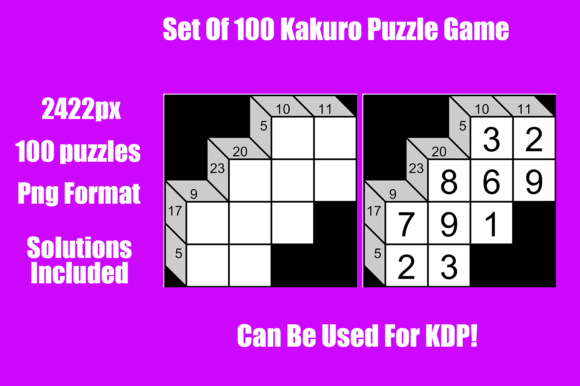
For example, if a clue indicates that two cells must sum to 3, the solver instantly knows the combination must be {1, 2}. However, if the clue is 17 across two cells, the only valid combination is {8, 9}. This immediate retrieval of integer partitions strengthens mental math fluency in a way that rote memorization cannot. The Set of 100 Kakuro Puzzle provides sufficient volume to move learners through various difficulty curves, reinforcing these neural pathways through repetition and progressive challenge. For adults, this dual-task requirement—simultaneously managing spatial constraints and arithmetic sums—serves as a robust exercise for working memory and executive function.
Technical Specifications for Print-Ready Publishing
For creators involved in Amazon KDP or other print-on-demand (POD) platforms, technical fidelity is non-negotiable. A common failure point in self-published puzzle books is low-resolution imagery that results in pixelated lines and blurry numbers when printed. This collection addresses those production risks through specific formatting choices.
- Resolution and Dimensions: Each file is delivered at 2422x2422 pixels. At a standard print resolution of 300 DPI, this allows for crisp reproduction at approximately 8x8 inches, which is ideal for both dedicated puzzle books and activity book inserts.
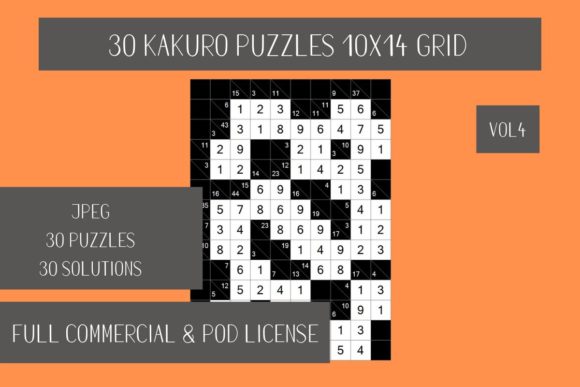
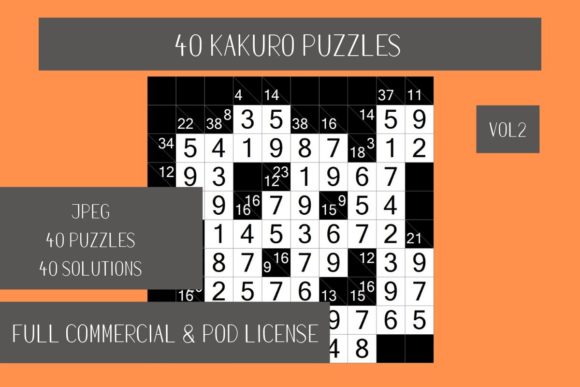
- PNG Format Advantages: Unlike JPEGs, which use lossy compression and can introduce artifacts around sharp lines and text, PNG files maintain perfect edge definition. This is critical for Kakuro grids where the distinction between a black cell, a white cell, and a diagonal divider line must be absolute.
- Solution Integrity: The inclusion of a separate folder containing solutions is a vital workflow component. It allows publishers to verify answers before printing and to create answer keys at the back of their books without having to solve 100 puzzles manually, significantly reducing time-to-market.
Integrating Assets into KDP Workflows
When incorporating this Set of 100 Kakuro Puzzle into a commercial product, layout strategy matters. Because the images are square, they offer flexibility in trim size selection. They fit naturally within 8.5 x 8.5 inch square formats popular for puzzle books, but can also be centered with ample margin space in 6x9 or 8.5x11 trade paperbacks. Creators should consider grouping puzzles by difficulty rather than random assortment. Since the set contains 100 distinct units, this allows for the creation of multiple smaller volumes (e.g., four books of 25 puzzles each) or a single comprehensive "Mega Collection." The high pixel count ensures that even if the image is scaled down for a pocket-sized edition, legibility remains uncompromised.
Pedagogical Applications in Mathematics Education
Educators and homeschoolers can leverage this set as more than just busy work; it serves as a scaffolded curriculum supplement for number sense. Kakuro is uniquely aligned with several core mathematical competencies found in primary and middle school standards.
Teaching Integer Partitions and Combinatorics
One of the most practical classroom uses for these puzzles is teaching the concept of partitions. Students learn that numbers can be broken down into constituent parts in specific ways. By working through the Set of 100 Kakuro Puzzle, students internalize addition facts up to 45 (the sum of 1 through 9). Teachers can create reference charts based on the puzzles themselves, asking students to identify all possible combinations for a given clue length and sum before attempting the grid. This transforms the puzzle from a test of knowledge into a laboratory for discovering numerical relationships.
Developing Logical Deduction Skills
Beyond arithmetic, Kakuro teaches the process of elimination and cross-referencing. A student might know that a horizontal row sums to 16 across three cells, while a vertical column intersecting one of those cells sums to 6 across two cells. Synthesizing these two pieces of information to find the single digit that satisfies both conditions is a foundational logic skill. This mirrors algebraic thinking, where variables are constrained by multiple equations. Using these high-resolution PNGs in worksheets or digital whiteboards allows teachers to model this deductive reasoning visually, zooming in on specific intersections without losing clarity.
Versatility Across Professional and Hobbyist Contexts
The utility of this asset pack extends beyond the classroom and the publishing house. Various professionals and hobbyists find specific value in having a ready-made library of logic puzzles.
- Corporate Wellness Programs: HR departments and team leaders often seek non-digital brain breaks for employees. Printed Kakuro sheets derived from this set can be included in wellness newsletters or breakroom materials, offering a screen-free cognitive reset that differs from typical word searches.
- Senior Care and Therapy: Occupational therapists and senior activity directors utilize logic puzzles to maintain cognitive acuity in aging populations. The clear, high-contrast nature of the 2422px PNGs ensures they can be printed at large sizes for those with visual impairments, making them accessible tools for geriatric care.
- Homeschool Co-ops and Tutoring: Tutors specializing in gifted education or learning differences often need enrichment materials that do not feel like remediation. Kakuro’s game-like structure masks its educational rigor, making it an excellent engagement tool for reluctant learners.
Strategic Considerations for Content Differentiation
While having a Set of 100 Kakuro Puzzle provides the raw material, success in either education or publishing depends on how that material is contextualized. In the saturated market of Amazon KDP puzzle books, differentiation is key. Simply compiling the images is rarely enough to capture audience attention.
Creators should consider adding instructional value. Since Kakuro has a steeper learning curve than Sudoku, including a "How to Solve" section that utilizes specific examples from the set can increase the perceived value of the book. Highlighting specific techniques, such as identifying unique sums or using pencil marks for candidate tracking, turns a simple puzzle collection into a guided course. Furthermore, because the files are individual PNGs, they can be interspersed with other content types. A math workbook might feature a Kakuro puzzle every fifth page as a review mechanism, breaking up dense textual content with interactive problem-solving.
Quality Assurance and Verification
Even with pre-solved files provided, best practices dictate a verification step. Before mass printing or distributing to students, spot-checking a sample of puzzles against the solution folder ensures alignment. This is particularly important if the files will be resized or reformatted, as layout shifts can occasionally occur during document assembly. Additionally, users should assess the difficulty distribution of the 100 puzzles. If the set skews heavily toward expert levels, educators may need to curate a subset appropriate for beginners, while publishers might market the collection specifically as "Advanced Kakuro" to target enthusiasts rather than novices.
The Long-Term Value of Digital Puzzle Assets
Investing in a standardized, high-resolution set of logic puzzles creates a reusable asset library. Unlike generating puzzles algorithmically on the fly, which can sometimes result in aesthetically poor or logically ambiguous grids, a curated set of 100 verified Kakuro puzzles offers consistency. The 2422x2422 pixel specification future-proofs the content; as display and print technologies advance, these files remain viable. Whether used to teach a child the joy of mathematical discovery, to help an adult maintain mental sharpness, or to build a passive income stream through KDP, the fundamental quality of the source material dictates the quality of the outcome. This collection bridges the gap between abstract mathematical concepts and tangible, engaging activities, serving as a multifunctional tool for anyone invested in logic, learning, or creative publishing.