Gridded Journal KDP Template: 8.5x11 Bleed Design
Creating a successful low-content book on Amazon KDP often comes down to the quality of your interior. While lined notebooks dominate the market, there is a significant and growing demand for structured layouts that support technical drawing, mathematics, and precise note-taking. A professionally formatted Gridded Journal KDP Template eliminates the guesswork from interior design, allowing publishers to focus on cover creation and marketing rather than pixel-perfect alignment. This specific 8.5 x 11 bleed-ready PDF provides an immediate foundation for creators looking to serve students, engineers, architects, and hobbyists who require accuracy in their physical notebooks.
Why Grid Layouts Outperform Standard Lined Paper
Standard college-ruled or wide-ruled paper serves general writing well, but it fails when users need spatial awareness. Grid paper offers a two-dimensional guide that supports both text and visual elements simultaneously. For KDP publishers, understanding this distinction is vital for targeting the right niche. When you utilize a dedicated gridded pages template, you are not just selling paper; you are selling utility. The uniform squares allow users to draw graphs, sketch UI wireframes, practice calligraphy, or map out garden beds without needing additional tools like rulers or protractors.
This versatility makes grid journals evergreen products. Unlike trendy planners that may expire after a year, a high-quality gridded notebook remains relevant regardless of the season. Professionals use them for project planning, while educators rely on them for STEM subjects. By offering a clean, bleed-designed interior, you position your book as a premium tool rather than a generic commodity. The 8.5 x 11 size further enhances this utility, providing ample surface area for detailed work that smaller trim sizes simply cannot accommodate.
Technical Specifications and Print Readiness
One of the most common reasons for KDP rejection or poor customer reviews is improper formatting. Margins that are too tight result in content disappearing into the spine, while incorrect bleed settings cause white borders to appear where color should extend to the edge. This template addresses those technical hurdles head-on. Designed specifically for the 8.5 x 11 trim size with bleed enabled, the file ensures that the grid pattern extends seamlessly to the page edge after trimming.
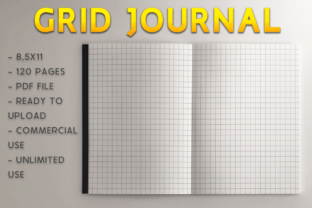
- Trim Size: 8.5 x 11 inches, the industry standard for academic and professional notebooks.
- Bleed Configuration: Pre-formatted to prevent white edges and ensure professional finishing.
- Page Count: 120 pages, striking the ideal balance between substantial utility and cost-effective printing.
- File Format: Single PDF file optimized for direct upload to the KDP dashboard.
- Grid Consistency: Uniform spacing maintained across all pages to prevent distortion during binding.
The 120-page count is strategically chosen for low-content publishing. It keeps the production cost low enough to maintain healthy royalty margins while still feeling substantial in the user's hand. Books under 100 pages can sometimes feel like pamphlets, whereas 120 pages conveys value and durability. Furthermore, having a pre-made PDF means you bypass hours of setting up master pages in InDesign or Canva, significantly reducing your time-to-market.
Practical Applications Across Diverse Niches
Success in KDP publishing requires matching the right interior to the right audience. A gridded journal is uniquely positioned to serve multiple distinct demographics. Understanding these use cases helps in crafting better titles, subtitles, and ad copy.
STEM Education and Academic Support
Students in mathematics, physics, chemistry, and engineering rely heavily on graph paper. Lined paper makes plotting functions or drawing molecular structures frustratingly difficult. Marketing this template toward back-to-school seasons or exam prep periods can yield strong results. The large 8.5 x 11 format is particularly appealing for college students who need space for complex equations and detailed diagrams alongside their lecture notes.
Design, Architecture, and Technical Drafting
Creatives and technical professionals often prefer physical media for initial ideation. Architects use grid paper for floor plan sketches, while graphic designers use it for logo construction and typography practice. Software developers and UX designers frequently use gridded notebooks for wireframing app interfaces before moving to digital tools. Because this template includes bleed, it mimics the look of high-end drafting pads, making it attractive to professionals who appreciate quality stationery.
Hobbyist and Craft Communities
Beyond professional and academic use, grid paper is essential for various crafts. Quilters use it for pattern design, cross-stitchers use it for charting, and model builders use it for scaling. These communities are highly engaged and often search for specific paper types. A gridded journal marketed specifically to quilters or model makers can face far less competition than a generic "graph paper notebook." The instant download nature of this template allows you to quickly create variations tailored to these micro-niches.
Maximizing Usability and User Experience
When evaluating or implementing a gridded template, consider the end-user's experience with the printed product. Not all grids are created equal. The line weight, opacity, and spacing determine whether a notebook is a joy to use or a frustration. Heavy, dark grid lines can interfere with handwriting and sketches, making the page look cluttered. Conversely, lines that are too faint may disappear when scanned or photocopied.
This template is designed with optimal contrast for KDP’s standard black-and-white printing. The lines are visible enough to serve as guides but subtle enough to remain in the background. This balance is crucial for user satisfaction and positive reviews. Additionally, the bleed design ensures that even if the user writes near the edge of the page, the grid structure remains intact. This attention to detail signals to the buyer that the publisher understands their needs.
Streamlining Your Publishing Workflow
Efficiency is the backbone of a sustainable KDP business. Creating interiors from scratch for every new book is unsustainable at scale. Using a verified, ready-to-upload Gridded Journal KDP Template standardizes your production process. You can purchase this asset once and use it as the foundation for dozens of different books by simply changing the cover and metadata.
- Download the PDF: Ensure you have the correct 8.5 x 11 bleed version.
- Create Your Cover: Design a cover that matches the 8.5 x 11 bleed dimensions.
- Upload to KDP: Select "Bleed" in the manuscript settings and upload the PDF.
- Preview: Always use the KDP Previewer to check margins and grid alignment before publishing.
- Publish: Set your pricing based on the 120-page print cost and launch.
This workflow reduces technical errors and frees up mental energy for keyword research and advertising. Instead of worrying about whether your grid lines align perfectly on page 60, you can focus on finding untapped keywords like "engineering graph paper notebook" or "quilt design journal."
Evaluating Quality Before You Publish
Before listing any low-content book, order a proof copy. Digital previews do not always reveal how ink interacts with paper. Check the grid opacity under different lighting conditions. Test various pens and pencils to ensure the paper quality (which is determined by KDP, not the template) works well with the grid density. Verify that the bleed extends correctly and that no critical grid lines are lost in the gutter margin.
Consider adding value beyond the grid itself. While this template provides the core 120 pages of gridded content, successful publishers often add a title page, a table of contents, or a "this book belongs to" page. These small additions transform a simple stack of paper into a cohesive product. Since this template is a PDF, you can easily merge it with other single-page PDFs using free tools before uploading. This customization capability allows you to differentiate your offering in a crowded marketplace while still leveraging the efficiency of a pre-made gridded pages template.
Ultimately, the goal is to provide a functional tool that solves a specific problem for your reader. Whether they are calculating load-bearing walls, designing a new font, or teaching geometry, the reliability of the grid matters. By starting with a professional, bleed-ready 8.5 x 11 template, you ensure that the physical product meets the expectations of discerning users, leading to better reviews, higher conversion rates, and a more reputable publishing portfolio.