Quad Ruled Graph Paper KDP Interior: Streamlining Your Low Content Publishing Workflow
For self-publishers and low-content creators, the difference between a hobby and a scalable business often lies in the efficiency of asset management. Sourcing or creating high-quality interiors from scratch for every new title is a significant bottleneck. A pre-formatted Quad Ruled Graph Paper KDP Interior serves as a foundational asset that eliminates technical friction, allowing you to focus on niche research, cover design, and marketing strategy. This specific interior template is engineered for immediate deployment, featuring 100 pages formatted specifically for Amazon’s printing specifications. By integrating this ready-to-print resource into your publishing workflow, you ensure consistency, reduce production time, and maintain professional quality standards across your catalog.
Technical Specifications and KDP Compliance
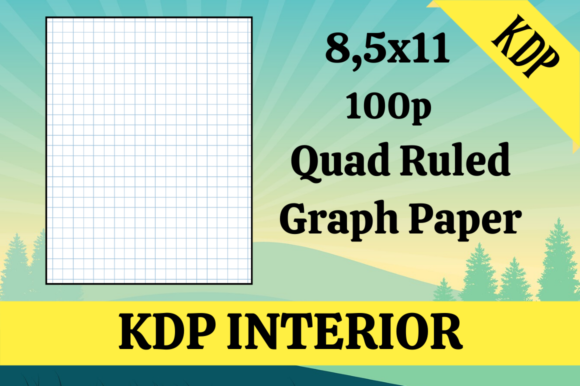
Understanding the technical parameters of this interior is essential for avoiding rejection during the upload process. This Quad Ruled Graph Paper KDP Interior is designed with a trim size of 8.5″ x 11″, which is the industry standard for academic notebooks, engineering logs, and general-purpose graph journals. Crucially, this file includes bleed. Bleed extends the grid lines beyond the final trim edge, ensuring that when the book is cut during manufacturing, the pattern reaches the very edge of the page without leaving an unprinted white border.
When uploading this file to Kindle Direct Publishing, you must select the “Bleed” option in the print settings. Failing to toggle this setting will result in KDP resizing your PDF to fit within no-bleed margins, which distorts the grid alignment and creates unwanted white borders. The included PDF files have been tested against current KDP guidelines to ensure proper margin safety and resolution. Having two variant PDF files allows for flexibility; you may choose between different line weights or opacity levels depending on whether your target audience prefers bold, high-contrast grids for markers or lighter lines for pencil work and scanning.
Integrating the Interior into Pre-Launch Planning
The utility of a standardized Quad Ruled Graph Paper KDP Interior begins before you even open the upload dashboard. During the niche validation phase, having a confirmed interior specification allows for more accurate competitive analysis. When researching bestsellers in the graph paper category, you can immediately identify gaps based on formatting. Many competitors fail because their interiors lack bleed or use non-standard sizes. Knowing your asset is 8.5″ x 11″ with bleed enables you to position your book as a premium alternative in your listing description and backend keywords.
Furthermore, this asset influences cover design dimensions. Because the interior dictates a bleed requirement, your cover file must be calculated using the exact page count (100 pages) and paper type associated with this interior. Using a pre-verified interior removes guesswork from spine width calculations. You can generate your cover template with confidence, knowing that the interior page count will not change during the proofing stage. This synchronization between interior and cover assets prevents the costly delay of redesigning covers due to last-minute interior adjustments.
Workflow Applications Across Different Niches
While "graph paper" seems generic, the practical application of this Quad Ruled Graph Paper KDP Interior varies significantly depending on the end-user's intent. Understanding these workflows helps in crafting targeted metadata and marketing copy.
- STEM Education and Tutoring: For students and educators, quad ruled paper is non-negotiable for geometry, calculus, and chemistry. The uniform grid aids in plotting functions and drawing molecular structures. In this workflow, the paper acts as a structural guide for learning. Marketing to this demographic requires emphasizing precision, line clarity, and the 8.5″ x 11″ size that fits standard binders and backpacks.
- Design and Architecture: Professionals and hobbyists use this format for sketching floor plans, UI wireframes, and scale drawings. Here, the paper serves as a rapid prototyping tool before digital execution. The bleed feature is particularly valued by designers who sketch to the edge of the page. Positioning this interior for creatives involves highlighting the paper's suitability for pencils, fine liners, and light marker use.
- Data Visualization and Analytics: Analysts and researchers often prefer physical graph paper for initial data exploration and charting trends before moving to software. The tactile process of drawing axes and plotting points facilitates cognitive processing. For this audience, the 100-page count represents a substantial project log or quarterly tracking journal.
- Cross-Stitch and Knitting Patterns: Crafters utilize quad ruled grids to map out pixel-based designs. Each square represents a stitch or row. In this context, the interior is a planning canvas. Creators targeting this niche should emphasize the grid size compatibility with standard embroidery counts.
Post-Publication Quality Control and Iteration
Even with a tested Quad Ruled Graph Paper KDP Interior, ordering a physical proof is a mandatory step in a professional workflow. Digital previews cannot replicate how ink interacts with paper stock. Upon receiving your proof, evaluate the line weight relative to the paper brightness. If the lines are too dark, they may overwhelm handwriting; if too light, they may disappear in low-light conditions or when scanned. The two included variants exist to solve this exact problem. If Variant A proves too heavy for your specific niche during proofing, switch to Variant B without needing to source a new file.
Check the bleed alignment physically. Measure the distance from the outermost grid line to the trimmed edge. Consistency across all 100 pages indicates correct file setup. Also, test the paper with various writing instruments relevant to your audience. If you are marketing to artists, test alcohol markers to check for bleed-through. While KDP standard paper has limitations, understanding its performance boundaries allows you to set accurate customer expectations in your book description, reducing negative reviews related to paper quality.
Scaling Your Low Content Business with Standardized Assets
Efficiency in low-content publishing comes from systematization. Treating this Quad Ruled Graph Paper KDP Interior as a modular component rather than a unique creation for each title allows for rapid scaling. Create a master project management board or spreadsheet where this interior is listed as a verified asset. When identifying a new keyword opportunity—such as "engineering student notebook" or "quilting graph journal"—you can bypass the interior creation phase entirely.
This standardization also simplifies series creation. If you plan to release a branded line of notebooks, maintaining identical interior formatting builds brand recognition and trust. Customers who purchase one volume know exactly what to expect from the next. The 100-page count becomes a signature specification. Over time, you can gather data on which niches perform best with this specific interior configuration, allowing you to double down on profitable segments while deprioritizing those that require custom formatting.
Optimizing Listings for Search Intent
Having a high-quality interior is only half the equation; customers must understand its value through your product page. Avoid generic descriptions. Instead, explicitly detail the specifications derived from this Quad Ruled Graph Paper KDP Interior. Mention the 8.5″ x 11″ trim size, the 100-page count, and the bleed-to-edge printing. Explain why these features matter. For example, "Full-bleed printing ensures no wasted margin space, maximizing your drawing area," translates a technical feature into a user benefit.
Utilize semantic keywords that reflect the workflows discussed earlier. Terms like "coordinate plane," "scale drawing," "stitch counter," and "data plotting" connect your book to specific user tasks. This aligns with Google’s Helpful Content principles by demonstrating that the book solves a tangible problem. Your description should read as a solution for a professional or student workflow, not just a list of dimensions. When customers see that you understand their specific use case for quad ruled paper, conversion rates improve regardless of price point.
Maintaining Long-Term Asset Viability
KDP specifications and printing technologies evolve. A responsible publisher periodically re-verifies their core assets. While this Quad Ruled Graph Paper KDP Interior is currently tested and compliant, schedule quarterly checks to ensure margin requirements or bleed tolerances haven't shifted. Keep the original source files or editable versions if possible, even if you primarily use the ready-made PDFs. This future-proofs your business against platform changes.
Additionally, monitor customer feedback specifically regarding the interior layout. Reviews mentioning "lines too faint" or "grid too small" are direct signals to revisit your variant selection or seek updated assets. Treat your interior files as living components of your business ecosystem. By maintaining rigorous quality control and staying attuned to user experience, this single asset can generate revenue across dozens of titles for years. The goal is to make the technical aspect of publishing invisible, allowing the value of the content and the utility of the tool to drive your business forward.