Tarot Journal for KDP: A Strategic Resource for Low-Content Publishing Success
Entering the Amazon Kindle Direct Publishing (KDP) marketplace requires more than just creativity; it demands strategic product selection and efficient execution. For publishers targeting the spiritual and self-care demographics, a Tarot Journal for KDP represents a high-potential asset. This specific type of low-content book serves a dual purpose: it provides end-users with a structured tool for documenting their spiritual practice, and it offers publishers a ready-made template that significantly reduces production time. By utilizing pre-formatted files available in PDF, PPTX, and Keynote, creators can bypass complex design software and focus on marketing and niche research.
The modern KDP landscape is competitive. Publishers often face the challenge of creating professional-grade interiors without expensive subscriptions to Adobe InDesign or Illustrator. Furthermore, finding a niche that balances search volume with manageable competition is difficult. The astrology and tarot niche remains evergreen, but success depends on offering superior user experience through thoughtful interior design. A well-structured Tarot Journal for KDP addresses these pain points by providing a tested, print-ready foundation that meets Amazon’s strict technical specifications while delivering genuine value to the customer.
Understanding the Tarot Journal for KDP Template
A Tarot Journal for KDP is not merely a blank notebook; it is a guided workbook designed specifically for tarot practitioners. The template described here is engineered for the standard 6x9 inch trim size, which is the industry standard for portable journals. It comprises 107 pages total, structured to maximize utility and minimize printing costs. With a calculated printing cost of approximately $2.15 USD, this format allows for healthy royalty margins even at competitive price points.
The interior architecture is deliberate. It begins with essential front matter, including a title page and a dedicated copyright page where you simply insert your brand name. This is followed by four Table of Contents pages. Unlike standard books where the TOC is static, these pages are designed for the end-user to hand-write reading references next to corresponding page numbers. This functional design choice transforms the journal into a searchable database of personal insights, increasing its perceived value over generic lined notebooks.
Core Interior Features and Layout
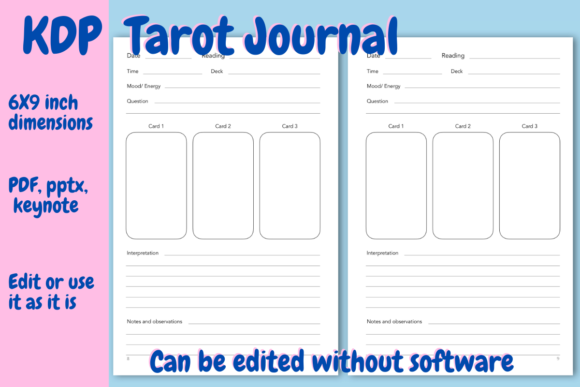
The heart of this Tarot Journal for KDP lies in its 100 dedicated reading pages. Each spread is meticulously laid out to capture the full context of a session. Rather than forcing users to adapt a blank page, the template provides specific fields that guide the reflection process:
- Date and Time: Essential for tracking astrological transits and moon phases during readings.
- Deck Used: Allows readers to track how different decks speak to them.
- Mood and Energy: Encourages mindfulness by recording emotional states before the reading.
- Question or Intention: Focuses the session on a specific inquiry.
- Visual Card Space: Three designated boxes allow users to draw or sketch the cards pulled, reinforcing visual memory.
- Interpretation and Notes: Ample lined space for synthesizing meanings and recording intuitive hits.
This comprehensive layout ensures that every page serves a purpose. The inclusion of numbered pages further aids organization, allowing users to cross-reference past readings via the Table of Contents. Because the document has been tested in the KDP Previewer, publishers can upload with confidence, knowing that margins, bleed, and safe zones comply with Amazon’s requirements.
Overcoming Technical Barriers with Accessible File Formats
One of the most significant advantages of this specific Tarot Journal for KDP resource is its accessibility. Traditional publishing workflows often require proprietary software that creates a financial barrier to entry. This template eliminates that hurdle by offering three distinct file formats: PDF, Keynote, and PowerPoint (PPTX).
For publishers who prefer a drag-and-drop interface without learning curves, the PowerPoint file is formatted specifically for Google Slides compatibility. This means you can edit, customize, and finalize your journal entirely within a free web browser. You do not need to purchase Microsoft Office or Apple Keynote. If you wish to expand the journal beyond 100 readings, you can simply right-click and duplicate pages within the slide editor. Conversely, if you want to create a shorter "starter" version, you can delete extra pages instantly. This flexibility allows you to create multiple variations of the same base product, testing different page counts and price points to see what resonates with your audience.
Elevating Your Business Through Niche Specialization
Success in low-content publishing often comes from niching down. While general gratitude journals are saturated, the intersection of tarot and astrology offers a dedicated audience seeking specialized tools. Elevating your KDP business involves positioning this Tarot Journal for KDP not just as a notebook, but as an essential companion for serious students of esoteric arts.
By focusing on the astrology niche, you align your product with specific search intent. Customers looking for tarot journals are often also interested in planetary alignments, retrograde periods, and lunar cycles. The template’s inclusion of "Mood/Energy" and "Date/Time" fields directly supports this crossover interest. When listing your book, use semantic keywords related to shadow work, daily pulls, spread documentation, and intuitive development. This signals to Amazon’s algorithm and potential buyers that your book is a specialized tool rather than a generic commodity.
Practical Applications and Customization Strategies
To maximize the potential of this template, consider how different user segments interact with tarot journals. Beginners often need structure to learn card meanings, while advanced readers need space for complex synthesis. The current layout serves both, but customization can help you target specific sub-niches.
Customization Ideas for Differentiation
Using the editable PPTX or Keynote files, you can modify the Tarot Journal for KDP to stand out in search results:
- Add Reference Sheets: Insert a quick-reference guide for Major Arcana keywords or moon phase meanings in the front matter.
- Create Themed Variations: Change the font styling or header graphics to appeal to specific aesthetics, such as "Dark Academia," "Celestial Minimalist," or "Boho Witch."
- Expand Specific Sections: Duplicate the reading pages to create a 200-page "Master Edition" or reduce them to 50 pages for a "Travel Size" version.
- Include Prompts: Add a small reflective prompt at the bottom of each reading page to encourage deeper journaling.
These modifications take minutes in Google Slides but significantly increase the uniqueness of your product. Remember that the base file is a starting point; your creative input is what builds a recognizable brand.
Implementation and Best Practices
When implementing this Tarot Journal for KDP into your publishing workflow, prioritize quality assurance. Even though the file is pre-tested, always download the latest KDP Previewer to check your customized version before publishing. Ensure that any text you add to the copyright page or headers stays within the safe zone. Since the printing cost is fixed at $2.15 for this 107-page configuration, calculate your royalties carefully. Pricing between $6.99 and $8.99 typically yields attractive margins while remaining impulse-buy friendly for the target demographic.
Finally, consider the customer experience beyond the book itself. The editable nature of these files allows you to create complementary digital downloads, such as printable tarot spreads or digital journaling templates, which can be linked in the back matter of your physical book. This creates an ecosystem around your brand, turning a single book sale into a long-term customer relationship.
By leveraging a professionally structured Tarot Journal for KDP, you remove the friction of design and technical formatting. This allows you to dedicate your energy to what truly grows a publishing business: keyword research, cover design, and understanding your audience's needs. Whether you are editing in Keynote, PowerPoint, or Google Slides, this resource provides the reliable foundation necessary to build a sustainable portfolio in the spiritual wellness niche.